Sunday, February 28, 2010

Hiroshima: Coming of age

The Japanese love to celebrate. They have holidays for everything, and coming of age is no exception. The second Monday in January is basically a giant birthday party for everyone who has turned twenty over the last year.

Twenty is a magic number in Japan. To turn twenty is to become an adult. You can drink, smoke, drive and vote.

Wikipedia will tell you that "many women celebrate this day by wearing furisode (a style of kimono with long sleeves that drape down). What Wikipedia does not tell you is that these beautifully dressed young women head to local parks and gardens to have pictures taken, much like Senior pictures for high school students in the states.

On our first day in Hiroshima we arrived too early to check in to our hotel and decided to spend the afternoon at Shukkeien Garden.


It was a beautiful place with everything you could ask for from an Asian garden. We meandered along gravel paths along the shore of a lake that reflected forests of bamboo and stoic old man trees.


The intention of the designer was to put all the wonders of nature in this tiny space. So a steep hill served as a mountain. One bank of the river was paved in smooth round stones to simulate a beach. And footbridges crossed streams pretending to be rivers.

Because we were there on coming of age day, the garden held an added element of beauty the designer never could have planned for - young Japanese women in furisode.

When I saw the first girl I raised my camera and took a picture. She noticed my attention and smiled for the next one.


We spent the next thirty minutes wandering around the garden looking for the perfect opportunity to snap a photo. I don't often wish for one of those big cameras with the removable zoom lenses. Most of the time they seem like more trouble than they're worth. But that day - what amazing images I could have captured.

These are the best of the ones I took. They're the kind of pictures that make me stop and wonder, "How did I get here?" It's funny to think that some of these girls were probably asking themselves the same question.


I leave you today with a quote from Tim Cahill, "I am living out my adolescent dream of travel and adventure."

Monday, February 15, 2010

Hiroshima - Hello

As we leave our comfy little Ryokan in Kyoto to once again board the bullet train, I think a bit on our next destination - Hiroshima.

In a little over an hour we will be Americans in Hiroshima. Americans in the city our military destroyed. I try not to think of it that way. I doubt that most Japanese think of us that way. After all, Hiroshima is a thriving modern city, welcoming tourism and the revenue it provides. Still I can't help but wonder if at least some of the older people will look at us with something like hatred. Would I, if the roles were reversed?

I wonder too, if traces of suffering will linger. Will it be a sad city or a hopeful one?

Soon I can stop wondering. We are there.

We leave the train station and enter a small park by the side of a river. Buildings reach for the sky on either side. The sky is gray. The air is cool. I take a picture of a faded orange elephant in the playground.


We cross a bridge, mostly because I think it's a pretty bridge and want to walk on it.

We notice our hotel is in sight, just a couple of blocks past the park. So far the city is gray but not sad, cool, but not unwelcoming. Of course, all that might change when we go to the memorials tomorrow.

But first, a surprise in the park.

Thursday, February 11, 2010

Kyoto - 'till I get lost

One last story about Kyoto before we move on to Hiroshima.

On the day we saw the thousand and one Buddhas we did a lot of walking. We walked from our hotel down a couple of blocks to the train station, then ten minutes to the temple, through the temple, in and around the National Museum, and then began an ill-fated quest to find another temple I had heard about.

By the time we headed back toward our hotel, my feet hurt and I was tired of walking. We decided to take the subway back to Kyoto train station.

Sadly, we ended up on the wrong train, confused by the map full of stations with names we'd never heard.

As we stood, swaying with the rhythm of the train, a little old Japanese man came up to us and said "Hello, welcome, welcome to Kyoto."

"Well, thank you." Grant said, with that slight southern twang that always makes me think of Elvis videos.

He asked us where we were from, we told him the United States. He said, "I visited your country. I was there three years."

Apparently, this old man had seen a lot in that three years. He talked about New York. He claimed that Maine was very small. I couldn't correct him. I just couldn't.

He said the trains were very bad in America, not nice, fast trains like in Japan. "You should build a train from Boston to Washington, D.C. when you get back to America."

Grant agreed. Strangely we'd just talked about that while on the Bullet Train to Kyoto. "Maybe when you are President. He could be President." The old man said to me. His eyes laughed.

He asked where Grant was from. Grant, of course, said Texas, though he hasn't lived there since he was a toddler. "Near Houston"

"I went to Texas," the old man said, "When I was in your country. I saw a very sad thing there."

I thought he was going to tell us about a car accident, or a family who was homeless, or some other tragic, but commonplace part of American life.

"Your President, Mr. Kennedy was shot. The police question me. They ask me what I saw. The shot came from the school book building. A very sad thing."

Grant and I nodded in sympathy and looked at each other, our eyes said, is he serious, was he really there?

We got off at the next stop. On the train ride back to Kyoto Station, I couldn't stop thinking about that old man. Did he really witness the Kennedy Assassination? Was he really standing in the crowd when someone shot an American President? Did he make the story up? Why? Did we misunderstand?

I leave you today with a quote from Napoleon Bonaparte, "History is the version of past events that people have decided to agree upon."

Monday, February 1, 2010

Kyoto: Everyday life is the path

We went in search of a Zen garden and found an aqueduct.

We didn't bring the guidebooks with us on the Japan world tour. They would have taken up too much room in our backpacks. Instead I carried a small plastic case full of note cards and small train maps. Each note card told me the name of a place and directions to get there from our hotel.
One of them said "Nanzen-ji" and under it the words "temple with zen garden". I knew that somewhere I had read about a Zen garden with raked gravel and carefully placed stones. Without my guidebooks, the only way of checking if this was the one was by going there and seeing for ourselves.

Nanzen turned out to be a beautiful, but otherwise unremarkable garden. It had a pond and a bridge arching over a spring and the ground was covered in moss between the foot trails. I was a little disappointed.

But just outside the garden we found something else that caught our attention: aqueducts.


From the ground we could see only a series of brick arches, stained with the passage of water and time. It reminded me of a train trestle.

But when we climbed the stone steps set into the side of the hill we found a deep trench of flowing water. A tiny wooden footbridge let us cross the aqueduct to an access path on the other side.


The path was deserted and quiet. I wanted to turn back, afraid we shouldn't be there. The drop down the side of the hill was steep, broken only by saplings and bamboo stalks. If we fell of the path it would be an unpleasant trip down. Falling the other direction, into the cold rushing water, didn't seem like a fun time either.

"They wouldn't have put a bridge there if they didn't want people up here." He was right. Besides, the path was more than wide enough for us to walk side by side without any danger of falling.

So, Grant and I walked along, accompanied by the sound of running water and our quiet conversation. At some point I looked around and realized we could be anywhere in the world. Trees, chill air, running water and a dirt path - if I stumbled upon this very scene in the woods of Maine it wouldn't have shocked me. We were half way around the world, and yet the world was exactly the same.


It was almost surprising to come out of the trees and see temples and family tombs laid out below us.

As we left the place I named Aqueduct Park, we stopped so Grant could take my picture on the steps of the huge gates to the complex of temples.

I guess it wasn't much like Maine after all.

I leave you today with a Zen proverb, "When you seek it, you cannot find it."

Wednesday, January 27, 2010

I see the forest and the trees


Sanjusangendo Temple was hard to miss. It was long and low and painted orange. We paid our fee to get in, then followed the signs through the courtyard to a low building. We took off our shoes in the vestibule. Grant had some trouble figuring out how to make his motorcycle boots fit on the little shoe shelves, but eventually we made it work.


We put on the little slippers provided for tourists and followed the trickle of people into the temple.


I wasn't supposed to take pictures, so you'll have to imagine it: 1001 statues in a low, dark, unheated room. They are staggered so you can see each face. And each is slightly different. Forty-two arms fan out around each one, 21 to a side, delicate hands outstretched and holding the tools of the Buddha.


They are like a forest of Buddhas, standing in a building that was old when Columbus first set foot on the new world. The slippers force you to shuffle across the wooden floor. Incense wafts from somewhere ahead and, in the same breath, chanting.


Eventually, you see a break in the Buddha-trees. It is as though you were walking through a forest of birches and suddenly you came upon an ancient sycamore. The Buddha in the center is twice as tall as the others. It glitters int he darkness. It's hands hold the tools of the Buddha, tools that save humans, tools that save worlds. And at its feet the monks are chanting.


Tears prick your eyes. You catch your breath. It is heavy with incense. The chant goes on and on. Others stop to bow, clap their hands and pray, but you are a Westerner, raised in a Western Church. It is enough for you to stand and stare. to let your awe become a prayer, your breath - praise, your heart beat - chanting.


Then you are moving again, shuffling past another 500 Buddhas. The chant never fades from your ears.


To see pictures of the inside of the temple including the 1001 Buddha's, click Here.


I leave you today with a quote from Shakespeare's As You Like It, "and this our life, exempt from public haunt, finds tongues in trees, books in running brooks, sermons in stones, and good in everything."

Sunday, January 17, 2010

Kyoto: We're big in Kyoto

We arrived on day four of our Japan world tour in the aggressively modern and massive Kyoto train station. A station so huge that we actually got lost in one of its many shopping centers while trying to find the exit.

We finally escaped onto a wide street lined with glassy high rise towers. That first view of Kyoto was deceptive. Walking about five minutes led us into streets so narrow we had to press against the walls to allow mopeds to pass. And pass they did, at about 60 miles an hour.

The Ryokan Shimizu is no trouble to find. Just walk down the tiny streets until you see the sign. Ryokan, in case you were wondering, means inn. And this was a traditional Japanese one.

We ducked under the half curtain and slid the door open. With our backpacks on, we easily filled the tiny foyer. Before we could step up into the lobby we had to take off our shoes and put on a pair of the Ryokan's slippers.


The man behind the counter checked us in and then led us up wooden steps to our room. He directed us to leave our sandals in the entryway before stepping up into the room.


The room itself was tiny, but it had all the amenities. Just to the right of the door was a sink and mirror. To the right of that was a tiny room holding only a toilet, with a heated seat of course, and a pair of bathroom sandals.


At the end of our tiny hall was a small bathing room. Half of the room was a bath tub deep enough to swim in. The other half was a shower. It had a drain in the floor and a shower head on a hook on the wall.


Finally he slid a door open and showed us our bedroom. The floors were tatami mats. Our beds, which lay directly on the floors, were three thin cushions with a foam pad on top. The comforters were covered with fitted sheets. I don't know why. The pillows were hard and thin.


We also had a tiny television, a table with tea things in a box on top, and a little basket full of towels and robes.


The windows really were made of thick paper, but they had glass on the outside to keep out the cold. The doors were only about five and half feet high. Grant hit his head on that door frame every day.


Other things that happened every day: we went exploring. We had to because the Ryokan rules said you had to be out of your room by 1000 and couldn't come back before 1600. Every time we left the staff handed us little hand warmer packs for our pockets and every time we returned they brought us little cups of orange tea.


They served breakfast as well, but Grant and I didn't eat any. A Japanese breakfast usually includes fish fillet, white rice, miso soup, some kind of fruit and green tea. Not the kind of thing I can stomach at eight o'clock in the morning.

Staying in the Ryokan was like staying at your grandmas house, if your grandma happened to be both Japanese and obsessed with cleaning.

I leave you today with a quote from my all time favorite show Futurama, "Welcome to Kyoto, the anagram lovers Tokyo."


Friday, January 15, 2010

Tokyo - The stage is all the world

This will be my last post about Tokyo. Next we move on to Kyoto.

Even with the lights up the theater is dim. We are on the fourth floor, in a tiny balcony with only two rows of red upholstered seats. Far below, a man in traditional Japanese garb stands before a background of cherry blossoms. I can't understand him, so my mind wanders. Paper bags and programs rustle. My earphone guide pipes plinking rainwater music int o my left ear.

Finally the man raises his arms and says what sounds like hiiooo. The crowd responds by clapping in rhythm 3-3-3-2. The man leaves this stage, causing an eruption of activity in the audience. Men in suits leave their seats. People talk and fidget. Bells ring as men and women pull out their cell phones to check one last message.

The curtain is pulled across by an unseen stage hand, blocking the cherry blossoms from sight and replacing them with a series of red, green and black stripes.

The drums begin and so does the commentary. It informs me that in this performance "the ritual [of the seven greens] and a tale of revenge are combined to create a graceful prayer for good fortune." While I am still puzzling through the psychology of this statement, the audience claps. The curtain has risen revealing a stage. Twenty men sit on red covered risers. Some have song books, others instruments. All are in traditional dress.

The three characters of the dance appear out of a rectangular hole in the stage. As they come into view members of the audience yell out the stage names of the actors.

The 'woman' wears a red kimono embroidered in gold and bits of green. The lining is white, her sash, yellow. Her headdress is an amazing sculpture of diamonds - it's hard to believe that this beautiful girl is really a man.

The other two actors, the Soga brothers, wear pale blue over garments with white designs on them. The legs are so long that they trail a yard past the actors' feet. Their undershirts are red with two white stripes running from sleeve to sleeve across the chest. Each carries a small drum.

The hands, necks and faces of all three are painted white. So they look like china dolls who have learned to dance.

Now they prepare for the ritual of the seven greens. The greens are eaten on the 7th day of the New Year, a ritual that is still performed to this day. Coincidentally, today is the seventh.

In this performance, the Soga brothers - figures of Japanese folk lore - prepare to seek revenge on the man who had their father killed. They do this by performing the ritual of the seven greens. During the ritual seven types of greens are picked, prepared and eaten.

The commentary informs me that "the Soga brothers' wish for success of their vendetta, and by extension, this becomes a wish for good fortune for all who watch this dance."

By now I am too engrossed in the stage to worry about the psychology.

The dancers move with perfect precision. The stamping of their wooden sandals stays in perfect time with the music. Now and then a fan calls out an actor's name, but I hardly notice. For a few moments there is only music and dance and the swirling colors of the actors clothes.

There is nothing in the Western world that even begins to compare to this. Forget ballet. Forget opera. This is Kabuki.

All too soon, it is over. The lights come up. We go on to our next adventure.

Today I leave you with a quote from Mata Hari, "The dance is a poem of which each movement is a word."

Monday, January 11, 2010

Tokyo: The space between

Sorry I'm a couple of days behind. So much is happening and I haven't had reliable Internet service. But I'll keep posting until I've told you all about it.

I noticed it the first time we arrived at the New Sanno. Outside the entrance to the hotel is a fountain in the middle of a round courtyard. The courtyard has a wall all the way around. Just visible over the wall, to the right of the hotel building, was a painting of a boy hugging his knees to his chest. The black and white paint showed amazing detail. If this was graffiti, it was very sophisticated graffiti.

Just below him, there was something else all together. It looked like a fanciful doodle with chalk on an old black chalk board, only it was 3 dimensional. It has words that I could just read over the top of the wall - No Man's Land.

Every time we walked into the hotel I noticed it and wondered what it was - a bar, a nightclub, a portal to another world? Finally we decided to investigate. On our way back from the Imperial Palace we detoured down a side street I thought might take us to the painting and the chalk board. It did, but we were no more enlightened than before. It was obviously a gate, a freestanding gate leading from nothing to nowhere. It looked like a dark cartoonists rendition of the torii gates found at the entrances to Shinto shrines.


Now I was really curious.

We went back to the hotel where I did what I always do when I'm curious - I googled it. Google promptly informed me that "No Man's Land" was a modern art display set up in the old French Embassy building. Seventy artists from France, Japan and maybe some other places got together and decorated everything - rooms, hallways, driveways and office furniture were all fair game.

The display would be dismantled at the end of January when it would be replaced with apartments. It was closed for the holiday, but would reopen on the sixth - today was the sixth. It was open until 6 pm; my clock said 4.

"We have to see this," I said. And this is what we saw.

- sheet metal paper airplanes crash landed into the driveway


- a graffiti Mario world complete with shells and coins


- a stairwell blocked by power cords that hung like vines


- an entire office spray painted silver from desk chair to stapler to floor

- a paper flower that sent tendrils out through windows and air vents

- a room covered in clay to look like bark

- a room filled waist high with shredded paper

- a family of Roomba robots sliding around a darkened room shining alphabet lasers on the floor from the end of long sticks strapped to their backs

- whole cities cut from books

and much more, so much I can't describe it. All I can say is if you live in Japan or can get here before Jan 31, you need to see this exhibit.

I leave you today with a quote from Charles Mingus, "Creativity is more than just being different. Anybody can plan weird; that's easy. What's hard is to be as simple as Bach. Making the simple, awesomely simple, that's creativity."

Friday, January 8, 2010

Tokyo: Today and Yesterday - part two

Yesterday we explored ancient Japan. First stop was Kabuki-za theater to see a Kabuki performance. Kabuki is an ancient Japanese style of theatre that tells stories with styalized dance set to live music.

Since a full show tends to be hours long and pretty expensive, we chose to see a single show. For about $9 each we got seats in a tiny balcony on the fourth floor. The story was about a pair of Japanese brothers who wanted revenge on their father's killer. They and their sister performed the ceremony of the seven auspicious herbs for luck in their quest to kill him.

The audio commentary broadcast through our headphones informed us that "in this performance the ritual and a tale of revenge are combined to create a graceful prayer for good fortune," and that "the Soga brothers wish for sucess of their vendetta, and by extension, this becomes a wish for good fortune for all who watch this dance." Yeah.

For more about our experince at the Kabuki theater, stay tuned. I'll be posting more over the next few days.

After the theater we traveled to the Imperial Palace. The East Gardens are open for public veiwing during most of the year. Though January isn't exactly prime garden viewing season, it was still impressive.

We saw gaurdhouses that have stood for centuries, palace walls five feet thick, and the ruins of an old castle building that burned down only 19 years after construction finished.

Time to pack up and start our trip to Kyoto.

I leave you today with a quote from Blaise Pascal, "Our achivements of today are but the sum total of our thoughts of yesterday."

Thursday, January 7, 2010

Tokyo: Today and Yesterday - part one

Yesterday we visited the symbols of modern Tokyo. First we checked out Tokyo Tower. Picture a red and white version of the Eiffel Tower. You can see the tip of it from all over Tokyo piercing the blue sky between dozens of average looking high rises.

But what use is a tower without an observation deck? Grant and I spent about twenty minutes up there trying to pick out landmarks from the slurry of buildings below. We could see as far as Yokohama in one direction and the outline of Mt. Fuji in the other. Sadly Mt. Fuji was too far away to photograph.

Then we vied with a bunch of Japanese kids for our chance to stand on a glass panel that looked down at the base of the tower. Finally, we crowded into an elevator with about twenty other people and headed down to the fourth floor.

Like any modern Japanese tourist sight, Tokyo Tower has gift shops, a food court and a series of attractions. These include a wax museum and a Guinness Book of World Records museum.

At the wax museum we saw Marlyn Monroe, Gandhi and the Beatles. I took a picture of Grant standing with Chairman Mao.

At the World Records museum Grant pretended to be the world's fattest man,


and I tried on a ring made for the world's tallest man.


Oh and did you know that the world's tallest snowman was built in Bethel, Maine? Well now you do.


After Tokyo tower we went back to the hotel for a nap and then it was off to Shibuya. Shibuya is modern Tokyo at its finest. Have you ever seen footage of crowds of pedestrians surging through a four way intersection in Tokyo with giant television screens showing advertisements in the background? Well that's Shibuya.

This section of Tokyo has more energy than anywhere I've ever visited. People perch like pigeons on every possible surface, no step or planter or railing is safe. Giggling Japanese girls stagger around in much-too-high heels. Metro Japanese boys fiddle with their cell phones as they drag shopping bags through the streets.

Grant and I found an Italian restaurant in a basement. It was one of those restaurants where you order your meal from a vending machine but it's brought to you by a girl.

Halfway through the meal Grant said, "I just realized that we're eating spaghetti with chop sticks."

On the way home we stopped for doughnuts at a Krispy Kreme. We watched donuts being made on a conveyor belt behind a plane of glass as we stood in line. When we finally reached the counter the girl handed us a pair of donuts fresh from the belt. "A present," she said. That's right, free donuts.

I leave you today with a quote from the sampler my great-grandmother had on her wall when I was a child, "Today is the tomorrow you worried about yesterday."

Tomorrow, I'll tell you about yesterday...or something.

Tuesday, January 5, 2010

Japan World Tour!

I know I haven't blogged on anything of consequence in a while, but all that is about to change. In about an hour Grant and I will begin our Japan World Tour. We will travel toTokyo, then Kyoto and finally Hiroshima before returning to Yokosuka on Jan 14.

I'll have my still camera and the brand new video camera Grant bought me for Christmas, so this will be most exstensively documented trip we've ever taken.

It will also be the lightest. Grant and I have managed to fit everything we need for 10 days of travel into two L.L. Bean backpacks. Since we will be traveling by train and on foot a lot of the time we didn't want to have to carry much.

I don't know what my internet access will be like, but I'll keep you as updated as possible.

I leave you today with a quote from Jacqueline Cochran, "I have found adventure in flying, in world travel, in business, and even close at hand... Adventure is a state of mind - and spirit."

Monday, December 7, 2009

Someone else's mirror

This weekend Grant and I had a very small adventure. We visited the Yokohama Archives of History. The building stands at the site where Japan and the U.S. signed the Treaty of Kanagawa, opening Japan's ports to the world.

All this sounds very academic, and it was. But it was also an existential adventure. In the courtyard we saw a Tabunoki Tree. They call this tree the last living witness to the signing of the treaty. Supposedly, after the great Kanto earthquake and the subsequent fires, this tree grew from the roots of the one standing in the same spot in 1854.

Me in front of the Tabunoki Tree in the courtyard.

Inside the museum, I got that Scooby-Doo-esque sensation that the reflection in the mirror wasn't mine, but someone else, aping my movements. It was disconcerting to see a time line listing China's Opium wars and the American Civil war as events that kept other countries from seeking trade relationships with Japan. One wall displayed a series of portraits of Commodore Perry, the U.S. Naval Officer who landed in Yokohama in 1854 and helped to open the ports of Japan.


One picture was an actual portrait of Perry from the Illustrated London News. The others were artist renditions of Perry, mostly drawn by people who had never seen him or a picture of him in their lives. There was one of him holding a Samurai sword, another of him with the long nose of a tengu, or heavenly dog. Only one of the six artist renditions looked anything like the actual man, and there was that using-someone-elses-mirror feeling again.

Exhibit after exhibit, I saw bits of American history skimmed through a filter of how they affected Japan.

In Scooby-Doo cartoons, the monster mimics someone, usually Shaggy, so well that he almost begins to wonder if that really is what he looks like after all. I wondered what the Americans who landed in Japan thought of the drawings and sketches showing the foreigners at work, at play, in foreign costume, eating foreign food, drinking foreign drinks, and living in strange houses like none the Japanese had ever seen.

Grant walking on a Yokohama survey map from 1881.

Did those Americans and Dutch and French who poured into Yokohama after 1854 ever wonder which of them was real, the self they knew, or the one they saw in the newspapers day after day?

I leave you today with a quote from Drew Carey, “I see my face in the mirror and go, 'I'm a Halloween costume? That's what they think of me?”

Thursday, November 19, 2009

Can you take a leap of faith...

On the rare occasions when Grant and I watch TV together we watch one of two channels, the Discovery Channel or the Travel Channel. One day, we watched a Discovery Channel special about the lights of Hong Kong.


Hong Kong is a city of skyscrapers. All of these buildings have lights on them. Some did mini light shows at one time of night or another. Then along came some bright guy who said, "Hey, what if all the buildings did their light show at the same time?" And thus the Hong Kong light show was born.


Think about that for a minute, an entire city coordinated into one giant light show. That's pretty darn Supercallifragilisticexpialidocious! So when we found out the ship would be going to Hong Kong, the light show was at the top of our list of things to do.


And that is how we found ourselves boarding the top floor of a double decker ferry (because everything in Hong Kong is double decker) and sailing across Victoria Harbor to Kowloon.


We waited, with a crowd of a couple of hundred toursits and locals on the Tsim Sha Tsui prominade.

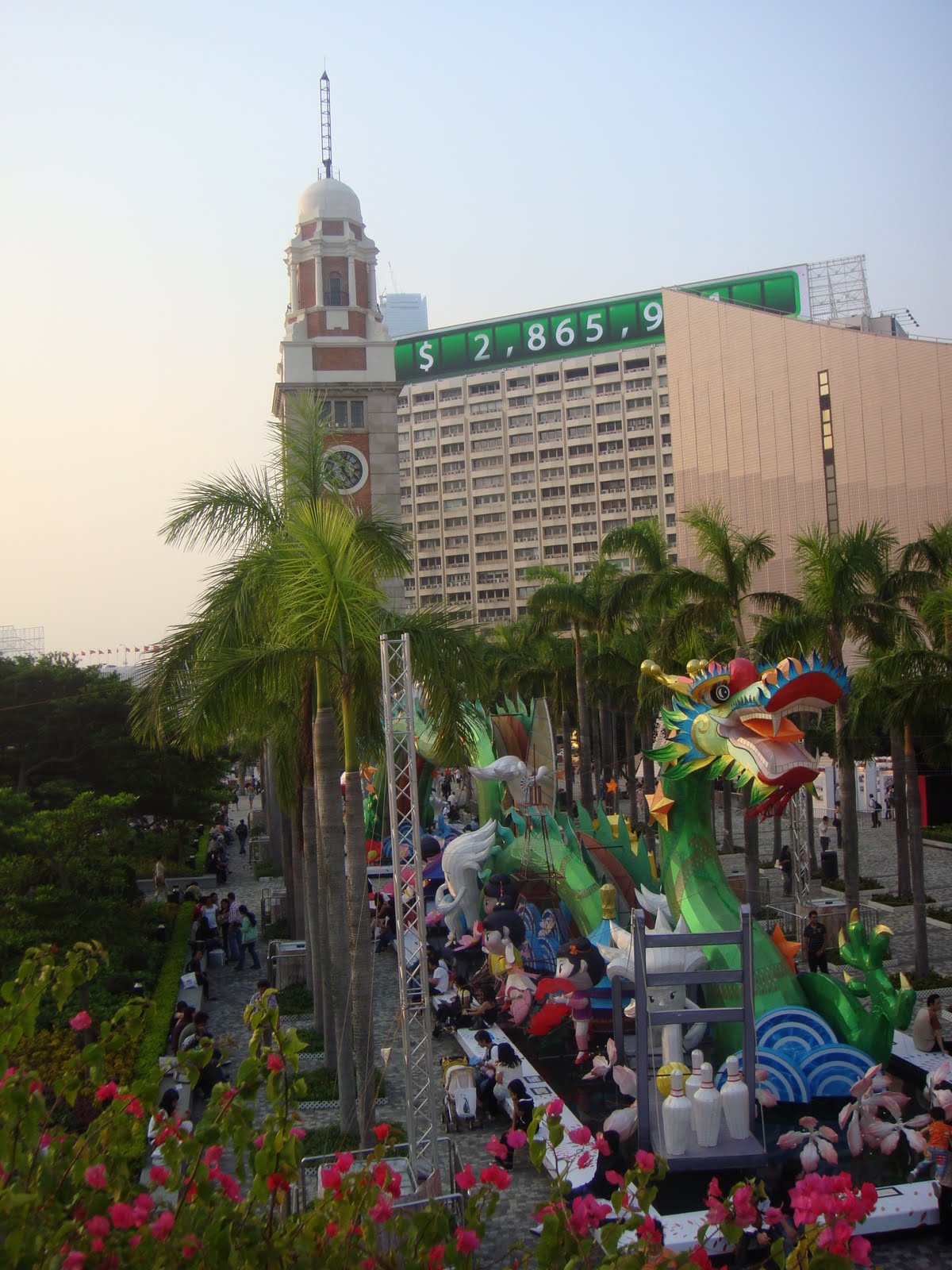
Junks and ferries bobbed on the water in front of us. Behind us KCR clock tower reached toward the sky, and a colorful dragon advertised the Asia Games. I asked Grant for the time every thirty seconds. Finally, it was eight o'clock.


A sound system poured music over the crowd and a pair of voices introduced the light show in English and Cantonese. At last it began.

Cameras shutters shnicked. The water turned purple and green and blue and white. The music played on, turning this flashing of lights into a dance.


Somewhere in the middle of all this I thought: "Holy crud, I'm on the discovery channel." Just months before I saw this on my television and now, here I was, standing in the middle of it. Remember the scene in Mary Poppins when they jump into the sidewalk art and dance through the pictures? It felt like that, but with an Asian soundtrack.


The videos don't do it justice. But I'll stick one on here anyway.


I leave you today with a quote from Mary Poppins, spoken by Bert the chimney sweep, "What did I tell ya? There's the whole world at your feet. And who gets to see it but the birds, the stars and the chimney sweeps." and me.

Saturday, November 7, 2009

Market day

disclaimer: Those with weak stomachs should probably never, ever visit Hong Kong.
Our second adventure was a trip to the market. And I'm not talking about a grocery store here, I'm talking about the real, old-fashioned, outdoor markets that have existed since the beginning of civilization. There are two major tourist attractiony ones in Hong Kong, Graham Street Market and Cat Street Market.

This is the entrance to Graham Street Market.

Graham Street is really just an alley, packed on either side with stalls and booths that sell almost anything imaginable to eat, along with some things that defy imagination.

This is a lovely vegetable stand.


As you can see, by stand, I mean pile of plastic crates full of various vegetables with a woman sitting in the middle of the pile.

All the vegetables looked perfectly fresh, no squishy tomatoes or wilted lettuce here. This stuff was probably picked within the last day. Graham street is a bit like a giant farmers market. Except for the man slicing fish in half while others swim in the tank beside him. Except for the 30 pound bags of rice with scoops in the top so you can measure out your portion. And except for the slabs of meat hanging from hooks complete with the occasional fly.

By the way, those things hanging over the tub with the fan to keep the flies away are entrails. Whose? I don't know. We gave that booth a wide berth.

At a less tourist-friendly market in the 'Old China' part of town we also saw a goat head stripped of half of its skin, but with horns still attached, and a man butchering a cow. I could tell it was a cow because he had the cows legs laid out on the table next to the giant head.

Fortunately, not all markets in Hong Kong are quite so gruesome.

Cat Street Market was devoid of all animal parts.


Though it did have a lot of animals carved out of jade and other ornamental stones, along with jewelry, clocks, teapots and scads of Chairman Mao memorabilia. I found presents for both of my parents here. Grant found a Chairman Mao pocket watch. It was lot like the mickey mouse watch I had as a kid, only instead of keeping time with his arm Mao just waved at whomever had opened the watch.

I leave you today with a quote from Tommy Smothers, "Red meat is not bad for you, now blue-green meat, that's bad for you."

Thursday, November 5, 2009

Getting High in Hong Kong

disclaimer: no drugs were abused in the making of this post

Our first adventure in the Hong Kong special administrative district was far removed from the usual hustle and bustle of the city proper. We took the amazingly simple to navigate Hong Kong subway system to Lantau island, the island just west of Honk Kong. We were headed for Ngong Ping Village and the Po Lin Monastery. What's the best way to get from the train station to the secluded monastery, you ask. Why by Skyrail of course. Otherwise known as a cable car.


So we waited in line to board a car with a woman and her mother who studiously ignored the no eating or drinking signs, a little girl who spent most of the time pasted to the window and a women with two young teenagers who spoke to each other in a disconcerting blend of Cantonese and English.

We climbed higher and higher until the entire Hong Kong airport lay like a particularly unattractive bath mat at our feet. The brochure called this "a spectacular view of Hong Kong International Airport." But I tend to agree with Douglas Adams who once said wrote, "It is no coincidence that in no known language does the phrase 'As pretty as an Airport' appear."


We saw fishermen with their boats, but soon left them behind as we climbed foothills much more swiftly than the men on the hiking trails below us.


Finally, it came into view, the thing we had come to see. At 110 feet it is the tallest seated outdoor Buddha statue in the world. He dwarfed our Kamakura great Buddha which is less than fifty feet tall. He dwarfed even the hill on which he sat.


Once again on the ground we stopped for lunch a little noodle shop with stand up tables. Don't let the little noodle shop and the brochures claiming that Ngong Ping is a Chinese style village fool you. There were four gift shops, several souvenir stands and a Starbucks under those clay tile roofs.


As we walked past the construction at the main entrance I wondered how the monks felt about all this. Did it bother them that their monastery had become a tourist attraction? Would the Buddha himself shake his head at the sight of a 250 metric ton statue of himself surrounded by six 10 foot tall statues of Devas offering gifts?


We climbed the 268 steps to stand on the platform just below the statue.


Inside the base of the statue was a museum, which we explored. And outside was a view like no other.


We took pictures, of the Buddha, of the Devas, of each other.


Back down the 286 steps we visited the monastery. There were a couple of small vegetarian cafes on the monastery grounds with signs that said, Please no meat or alcohol.


There were also huge pots full of incense sticks releasing pennants of smoke into the air. A sign said: warning, incense brazier is hot.


Oh yes, the Buddha was definitely laughing at us.


I leave you today with a quote from the Buddha, "When you realize how perfect everything is you will tilt your head back and laugh at the sky."

For more pictures please visit my Picasa album at: http://picasaweb.google.com/read.read.rose/TianTanBuddha?feat=directlink